
Playbooks · Lead recovery · 10 min read
A Practical Missed Lead Recovery Checklist for Small Teams
Capture, deduplicate, assign, follow up, test, and audit enquiries with a practical missed-lead recovery system for small teams.
Direct answer
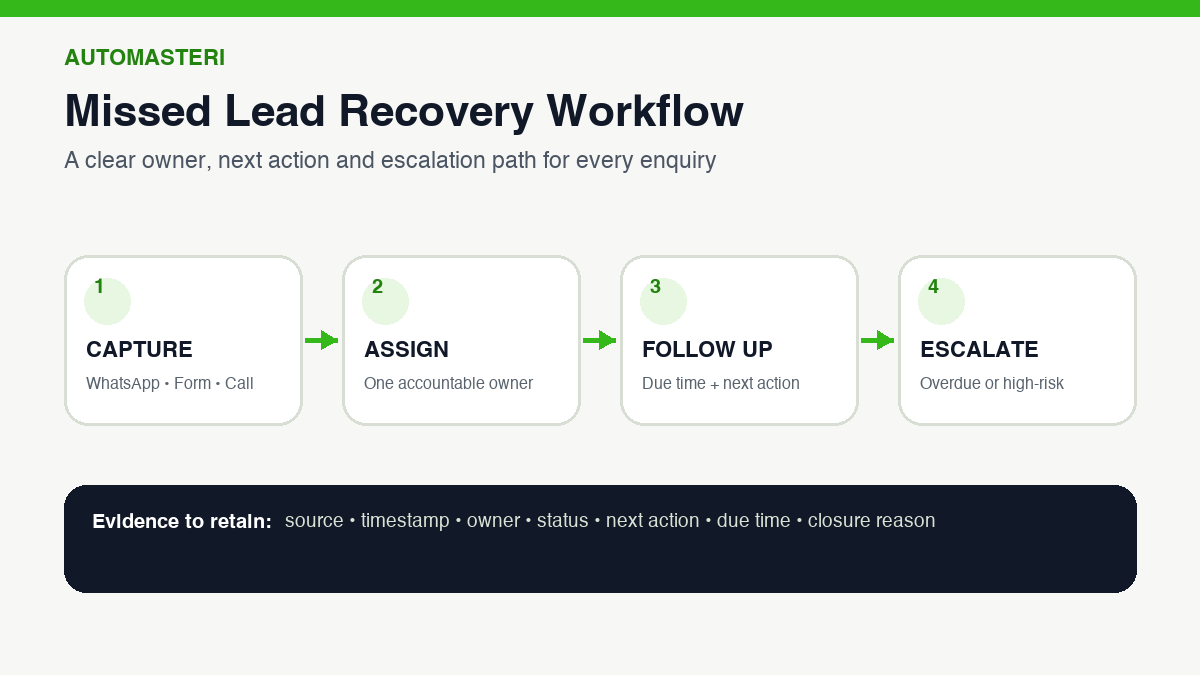
A missed lead recovery checklist should do more than send a fast reply. It should prove that every enquiry was captured once, assigned to a real owner, acknowledged through an allowed channel, given a next action, followed up on time, and closed with an outcome. It should also show when automation stopped and a person took over.
The minimum useful system is a queue plus an evidence register. If the team cannot answer “Who owns this lead, what happens next, and when is it overdue?” without searching several inboxes, the recovery process is not yet reliable.
Start with an intake map, not a new tool
List every place an enquiry can arrive:
- website contact, quote, audit, and booking forms;
- WhatsApp messages and click-to-WhatsApp ads;
- Meta lead forms;
- Google Ads lead forms;
- email enquiries;
- missed calls and call-back requests;
- referrals, marketplaces, and manually entered walk-ins.
For each source, record the source name, destination, access owner, backup owner, business hours, required consent or notice, and the event that creates a lead record.
This matters because platforms deliver different evidence. Meta says lead ads can be retrieved with webhooks or bulk read, and its webhook event includes identifiers such as leadgen_id, form_id, ad_id, and created_time. Google documents that lead-form submissions can be posted to a configured webhook and recommends using lead_id for deduplication. WhatsApp messages webhooks distinguish incoming user messages in a messages array from business-message delivery states in a statuses array. Those fields should be mapped deliberately rather than flattened into an untraceable “new lead” notification.
Use one deduplication key per source
Duplicate records create a quieter version of the same problem: two people reply, nobody knows which record is authoritative, or a test lead enters the sales queue.
Use the platform identifier when one exists:
- Meta leadgen_id for a Meta lead-form event;
- Google lead_id for a Google lead-form event;
- WhatsApp message ID for the inbound message event;
- your own submission ID for a first-party website form;
- a call event ID from the call system, if available.
Keep phone or email as contact attributes, not as the only event key. One person may make two legitimate enquiries about different services. Conversely, the same webhook may be delivered again and should not create a second lead.
Google's implementation guidance also says handlers should ignore unrecognised fields for forward compatibility. A safe receiver therefore validates required fields, stores the raw event securely for a limited period where lawful, ignores fields it does not understand, and uses the event ID to make processing idempotent.
Create the minimum lead evidence register
Every accepted lead should produce one row or record containing:
- source and campaign or form identifier;
- source event ID;
- received timestamp in UTC;
- customer-provided contact details;
- consent or request context;
- stated requirement;
- assigned owner and backup owner;
- acknowledgement timestamp and channel;
- next action and due time;
- current status;
- last human review;
- final outcome and reason.
Avoid collecting fields merely because a platform can send them. Keep what is needed for the enquiry, security, attribution, follow-up, and lawful records. Restrict access to people who need the information, and define retention rather than keeping every raw payload forever.
Separate acknowledgement from marketing
An acknowledgement confirms that the enquiry arrived and explains what will happen next. It should not silently enrol someone in an ongoing promotional sequence.
For WhatsApp, the current Business Messaging Policy says a business may contact people only after receiving their number and opt-in permission, must respect opt-out requests, may initiate conversations only with approved message templates, and may reply without a template within 24 hours of the last user message. It also requires a clear path to human escalation when automation is used.
For UK-directed electronic marketing, the ICO distinguishes a message someone actively requested from unsolicited marketing, recommends clear positive consent where required, and says organisations should record what the person consented to and when and how it was obtained. Other countries can impose different or stricter rules. Treat this as an operational warning, not legal advice: identify the recipient's jurisdiction and get qualified advice for the markets you contact.
A safe first acknowledgement contains:
- the business name;
- the enquiry topic;
- confirmation that the request was received;
- the expected next step;
- a realistic response window defined by the business;
- a way to correct the request or reach a person.
Do not promise a universal five-minute response if the team cannot consistently meet it.
Assign ownership before sending follow-up
Automation without ownership produces polished neglect. Every lead needs one accountable owner and one fallback rule.
Define:
- who owns each source during business hours;
- what happens outside business hours;
- when an unaccepted assignment escalates;
- who handles pricing, legal, payment, account-access, security, or angry-customer cases;
- when the lead is returned to a shared queue;
- who may mark a lead closed.
The owner should accept or reject the assignment. A notification being delivered is not proof that a person accepted responsibility.
Use a decision tree for the next action
Apply this small decision tree after capture:
1. Is the event authentic and complete? - No: quarantine it for review; do not message. - Yes: continue. 2. Is it a duplicate event? - Yes: attach the delivery attempt to the existing record. - No: create the lead. 3. Did the person request this contact or provide valid channel permission? - Unclear: hold promotional follow-up and request human review. - Yes: continue with the permitted acknowledgement or reply. 4. Is the enquiry sensitive, high-value, angry, unusual, or related to money, law, security, or account access? - Yes: assign a person before any substantive reply. - No: send the approved acknowledgement and set the next action. 5. Has the owner accepted the lead? - No: escalate after the internal acceptance window. - Yes: start the agreed follow-up schedule.
This decision tree prevents speed from becoming the only measure of quality.
Build a follow-up ladder the team can actually run
Do not copy an arbitrary sequence from another business. Set timing from business hours, sales cycle, urgency, customer request, channel rules, and team capacity.
A practical ladder can include:
- acknowledgement after validated capture;
- owner acceptance;
- first human response;
- next-day or agreed-date follow-up;
- one later reminder when permission and context allow;
- escalation for high-intent leads with no owner action;
- closure or nurture status with a recorded reason.
Stop automatically when the person opts out, the address is invalid, a complaint or sensitive issue appears, the lead is already converted, or a person takes control of the conversation.
Test the recovery workflow with evidence
Run tests before connecting real campaigns or increasing spend. Use clearly labelled test records and remove them from business reports afterward.
Test at least these cases:
- one valid event from every source;
- the same event delivered twice;
- a payload with an unknown optional field;
- a payload missing a required identifier;
- a test-lead flag where the platform provides one;
- an invalid webhook key or signature;
- an owner who does not accept the lead;
- an opt-out or do-not-contact request;
- a high-risk enquiry that must reach a person;
- a delivery failure and retry;
- an outage followed by replay or bulk recovery.
For Google lead forms, validate the configured google_key before processing and use lead_id for deduplication. For Meta, verify the required lead-access permissions and test both webhook delivery and the documented recovery/read path. For WhatsApp, distinguish sent, delivered, read, and failed status evidence; “sent” alone does not prove delivery or a human response.
Record the expected result, actual result, timestamp, tester, and cleanup result for every case.
Review four measures every week
Use measures the team can verify:
- capture completeness: accepted source events compared with created lead records;
- duplicate rate: repeated events that were safely attached rather than recreated;
- owner acceptance: leads accepted within the internal window;
- overdue next actions: open leads whose next action has passed.
Response time can be useful, but it should not reward unsafe automated replies. Pair it with outcome reasons, opt-outs, escalations, and unresolved high-risk cases.
What to do today
Pick one lead source and trace a test enquiry from submission to final record. Confirm the event ID, received time, assigned owner, acknowledgement, next action, escalation path, and closure evidence. Fix the first missing handoff before adding another automation.
If a guided review is useful, AutoMasteri currently offers a free automation audit and application-only mentorship route; it does not publish a confirmed paid entitlement or guarantee an outcome.
Sources
1. Meta, “Retrieving Leads,” updated May 21, 2026, accessed September 15, 2026: https://developers.facebook.com/docs/marketing-api/guides/lead-ads/retrieving/ - Supports webhook or bulk lead retrieval, required access permissions, webhook identifiers, and leadgen_id retrieval. 2. Google for Developers, “Lead Form Webhook — Overview,” last updated August 20, 2025, accessed September 15, 2026: https://developers.google.com/google-ads/webhook/docs/overview - Supports direct webhook delivery of Google Ads lead-form submissions into a configured CRM endpoint. 3. Google for Developers, “Lead Form Webhook — Implementation,” accessed September 15, 2026: https://developers.google.com/google-ads/webhook/docs/implementation - Supports google_key validation, lead_id deduplication, test-lead handling, forward-compatible unknown fields, and webhook response behaviour. 4. Meta, “messages webhook reference,” updated June 17, 2026, accessed September 15, 2026: https://developers.facebook.com/docs/whatsapp/cloud-api/webhooks/components - Supports the distinction between inbound messages, outbound status events, delivery states, and error locations. 5. WhatsApp, “WhatsApp Business Messaging Policy,” accessed September 15, 2026: https://business.whatsapp.com/policy - Supports opt-in and opt-out requirements, approved-template initiation, the 24-hour reply window, data protection, and human escalation. 6. UK Information Commissioner's Office, “Electronic and telephone marketing,” updated August 20, 2025, accessed September 15, 2026: https://ico.org.uk/for-organisations/direct-marketing-and-privacy-and-electronic-communications/guide-to-pecr/electronic-and-telephone-marketing/ - Supports the solicited/unsolicited distinction, positive consent, consent records, withdrawal, and the warning that international campaigns must consider destination-country law.
Build the map before the tools.
Start with the free AutoMasteri automation audit, or apply for a mentor review if you want Reji to review the operating system behind your customer journey.